
Introduction
Budding is one of the most effective methods of plant propagation. It helps gardeners and farmers produce healthy plants with the same characteristics as the parent plant. Unlike growing plants from seeds, budding creates genetically identical plants with predictable growth and fruit quality.
This technique joins a single bud from a desired plant, called the scion, to another plant known as the rootstock. Once the two parts heal together, the bud grows into a new shoot. As a result, the new plant combines the best qualities of both plants. The scion provides the desired flowers or fruits, while the rootstock offers strong roots and disease resistance.
Budding is widely used in horticulture because it requires only one healthy bud instead of an entire stem. Therefore, it saves valuable plant material and allows growers to propagate many plants from a single parent plant. It is especially popular for fruit trees such as citrus, apples, peaches, and pears, as well as ornamental plants like roses.
Although budding is often confused with grafting, the two methods are different. Grafting usually uses a stem with several buds, whereas budding uses only one bud. Consequently, budding is often quicker, more economical, and easier for many plant species.
In this guide, you will learn everything about budding in plants, including its definition, working process, different budding methods, step-by-step procedure, advantages, common applications, and expert tips for achieving a high success rate.
What Is Budding in Plants?
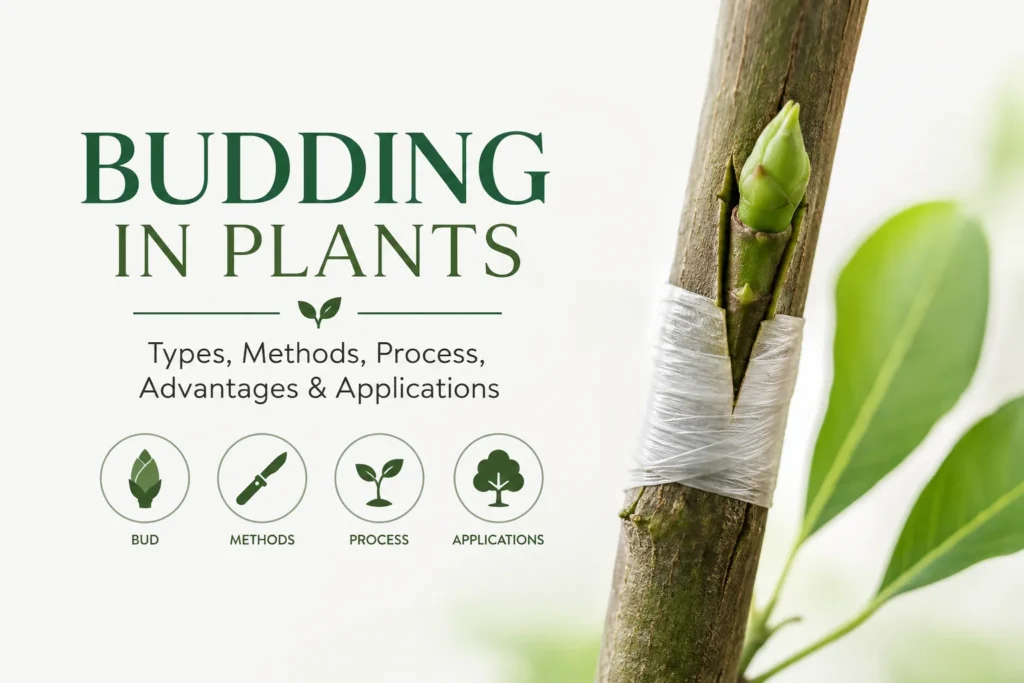
Budding is an artificial method of vegetative propagation in which a single healthy bud from one plant is attached to the stem of another compatible plant. The attached bud eventually grows into a new branch after the tissues heal together.
The plant that provides the bud is called the scion, while the plant that provides the root system is known as the rootstock. Successful budding depends on the proper union of their cambium layers, which are the actively growing tissues located beneath the bark.
Since budding is a form of asexual propagation, the new plant is genetically identical to the parent plant that supplied the bud. This helps growers maintain desirable characteristics such as fruit quality, flower color, growth habit, and disease resistance.
Compared to other propagation methods, budding is highly resource-efficient. A single branch containing many healthy buds can produce dozens of new plants. Therefore, commercial nurseries often prefer budding when propagating valuable fruit trees and ornamental plants.
Key Characteristics of Budding
- Uses a single healthy bud instead of an entire stem.
- Produces genetically identical plants.
- Combines desirable scion traits with vigorous rootstock.
- Requires compatible plant species.
- Commonly used in horticulture and commercial nurseries.
- Saves scion wood and propagation costs.
How Does Budding Work?
The success of budding depends on the formation of a strong connection between the bud and the rootstock. This connection allows water, nutrients, and sugars to move freely through the new plant.
The process begins by selecting a healthy bud from a mature shoot. A matching cut is then made on the rootstock. The bud is carefully inserted into this opening so that the cambium layers of both plants touch each other.
After the bud is secured with budding tape or rubber strips, the exposed tissues begin to heal. During this healing stage, specialized cells form a protective tissue called callus. This callus gradually joins the bud and rootstock into a single living plant.
Once the union becomes strong, the bud starts receiving water and nutrients from the rootstock. Eventually, the bud develops into a vigorous new shoot that carries the characteristics of the parent plant.
The Budding Process in Simple Steps
- Select a healthy rootstock.
- Collect a mature bud from the desired plant.
- Make matching cuts on the rootstock.
- Align the cambium layers carefully.
- Wrap the bud securely.
- Allow the graft union to heal.
- Remove the wrapping after healing.
- Prune the rootstock above the new bud to encourage growth.
Requirements for Successful Budding
Successful budding is not based on luck. Instead, it depends on choosing the right plant materials, using proper techniques, and performing the operation at the correct time. Even a small mistake can reduce the success rate. Therefore, understanding the basic requirements is essential before starting the budding process.
Species Compatibility
The scion bud and the rootstock must be botanically compatible. In most cases, budding works best between plants of the same species or closely related species.
For example, different citrus varieties can usually be budded onto citrus rootstocks. Similarly, many apple varieties are compatible with apple rootstocks. However, attempting to bud unrelated plants rarely results in a successful union because their tissues cannot heal properly.
Generally, the closer the relationship between two plants, the higher the chances of successful budding.
Mature Scion Buds
Always select healthy, mature buds from vigorous plants. The bud should be free from diseases, insect damage, and physical injuries.
Avoid using very young or weak buds because they contain fewer stored nutrients. Mature buds have better energy reserves, making them more likely to establish quickly after budding.
Collect budwood from plants that are actively growing but not producing excessive soft growth.
Proper Cambium Alignment
The cambium is a thin layer of actively dividing cells located between the bark and the wood. It plays a critical role in forming the graft union.
During budding, the cambium layers of the scion and rootstock must touch each other. Even slight misalignment can prevent proper healing and cause the bud to fail.
For this reason, experienced growers pay close attention to positioning the bud accurately before wrapping it.
Sharp and Sterile Tools
Clean cuts heal faster than rough or damaged cuts. Therefore, always use a sharp budding knife or grafting knife.
Sterilize cutting tools before working on each plant. This simple practice helps prevent the spread of bacterial, fungal, and viral diseases from one plant to another.
Sharp tools also reduce tissue damage, improving the overall success rate.
Bark Slipping (For Specific Methods)
Some budding techniques, especially T-budding (Shield Budding), require the bark to separate easily from the wood. This condition is known as bark slipping.
Bark slipping usually occurs when plants are actively growing during the mid to late growing season. If the bark does not slip easily, methods such as chip budding are usually a better choice.
Choosing the correct budding method based on bark condition significantly increases the likelihood of success.
Types of Budding Methods
Different plants require different budding techniques. The best method depends on the plant species, bark condition, season, and the grower’s experience. Some methods work best when the bark separates easily, while others are suitable when it does not.
T-Budding (Shield Budding)
T-budding, also called Shield Budding, is the most popular budding method used in commercial nurseries. It is simple, reliable, and provides a high success rate when performed during the right season.
In this method, the rootstock receives a T-shaped cut, and a shield-shaped bud is inserted beneath the lifted bark. The bark is then wrapped securely while leaving the bud exposed.
Because this method depends on the bark lifting easily, it should only be performed when the bark is slipping naturally.
How T-Budding Works
- Make a vertical cut on the rootstock.
- Add a horizontal cut at the top to form a “T.”
- Gently lift the bark flaps.
- Cut a healthy shield-shaped bud from the scion.
- Slide the bud beneath the bark.
- Wrap tightly with budding tape.
- Leave the bud uncovered.
Best Time
T-budding performs best during mid to late summer, when the bark separates easily from the wood due to active sap flow.
Suitable Plants
- Citrus trees
- Roses
- Peach
- Plum
- Apricot
- Cherry
- Many ornamental shrubs
Advantages
- High success rate.
- Uses very little scion wood.
- Quick and easy to perform.
- Strong graft union.
- Widely used in commercial nurseries.
Limitations
- Requires slipping bark.
- Cannot be performed during dormancy.
- Needs careful cambium alignment.
Chip Budding
Chip budding is an excellent alternative when the bark does not slip. Instead of lifting the bark, both the bud and the rootstock receive matching wedge-shaped cuts.
The bud fits precisely into the matching notch on the rootstock. Since the bark remains attached, this method can be used over a longer growing season than T-budding.
Many fruit tree nurseries prefer chip budding because it provides consistent results under different conditions.
How Chip Budding Works
- Remove a small chip of wood from the rootstock.
- Cut a matching chip containing a healthy bud.
- Fit both pieces together carefully.
- Align the cambium layers.
- Wrap tightly until healing occurs.
Best Time
Chip budding is commonly performed during:
- Spring
- Early autumn
- Whenever bark is not slipping
Suitable Plants
- Apple
- Pear
- Cherry
- Pear
- Plum
- Ornamental trees
Advantages
- Does not require slipping bark.
- Longer working season.
- Strong bud attachment.
- Suitable for cooler climates.
Limitations
- Requires very accurate cuts.
- Takes slightly more practice.
- Proper alignment is essential.
Patch Budding
Patch budding is mainly used for plants with thick or tough bark. Instead of inserting a small bud beneath the bark, both the rootstock and the scion exchange rectangular patches of bark.
This larger contact area improves healing in species where traditional T-budding is difficult.
Commercial growers often choose patch budding for nut trees and certain tropical crops.
How Patch Budding Works
- Remove a rectangular bark patch from the rootstock.
- Cut an identical bark patch containing a healthy bud.
- Replace the removed patch with the bud patch.
- Secure tightly with budding tape.
Best Time
Patch budding works best during the active growing season when bark removal is easier.
Suitable Plants
- Walnut
- Pecan
- Rubber tree
- Mango (in some regions)
Advantages
- Ideal for thick bark.
- Strong cambium contact.
- High success on difficult species.
- Excellent for commercial production.
Limitations
- Requires precise cutting.
- More time-consuming than T-budding.
- Not suitable for thin-barked plants.
Flute Budding
Flute budding removes a complete ring of bark from the scion and replaces a matching ring on the rootstock.
This method is mainly used for pecans, walnuts, and other nut trees with thick bark.
Advantages
- Excellent cambium contact.
- Strong graft union.
- Suitable for large buds.
Limitations
- Difficult for beginners.
- Requires precise bark removal.
Ring (Annular) Budding
Ring budding, also known as annular budding, replaces a complete ring of bark on the rootstock with one containing a healthy bud.
Although effective, it is less common today because it requires careful handling and can stress the rootstock.
Common Uses
- Experimental propagation
- Specialized nursery production
- Selected fruit tree species
Pocket Budding
Pocket budding creates a small pocket in the bark of the rootstock rather than a T-shaped cut. The bud is placed inside this pocket and wrapped securely.
This technique is used only for certain fruit trees and specialized nursery operations.
I-Budding
I-budding uses an I-shaped incision instead of a T-shaped cut. The bark opens differently, making it useful for selected plant species where traditional T-budding is less effective.
Although it is not widely practiced, experienced propagators may use it in commercial nurseries for particular crops.
Step-by-Step Budding Process
Successful budding requires careful preparation and attention to detail. Each step plays an important role in forming a strong graft union. Therefore, following the correct procedure can greatly improve the success rate.
Below is a simple guide to performing budding in plants.
Step 1: Collect Healthy Budwood
The first step is selecting healthy budwood from a vigorous parent plant. The budwood should come from a disease-free plant that produces high-quality flowers or fruits.
Choose mature shoots with well-developed buds. Avoid weak, damaged, or diseased branches because they may reduce the chances of successful budding.
It is also best to collect budwood early in the morning when the plant is well-hydrated.
Tips for Selecting Budwood
- Choose healthy, vigorous plants.
- Select mature buds.
- Avoid flowering shoots.
- Do not use diseased branches.
- Keep budwood cool until use.
Step 2: Remove the Leaves
After collecting the budwood, remove the leaf blades carefully. However, leave a short portion of the leaf stalk, called the petiole, attached to each bud.
The remaining petiole acts as a convenient handle during budding. It also helps determine whether the bud has successfully healed. If the petiole falls off naturally after a few weeks, it usually indicates a successful graft union.
Avoid damaging the bud while removing the leaves.
Step 3: Prepare the Bud Shield
Using a clean and sharp budding knife, cut a shield-shaped piece of bark containing the selected bud. The cut should be smooth and even.
Depending on the budding method, the shield may include a thin layer of wood or only the bark.
Avoid touching the cut surface with your fingers because this can introduce contaminants and reduce the success rate.
A Good Bud Shield Should Be
- Smoothly cut
- Fresh and moist
- Free from damage
- Properly sized for the rootstock
Step 4: Prepare the Rootstock
Next, prepare the rootstock by making the appropriate cut.
The type of cut depends on the budding technique you are using.
- T-budding: Make a T-shaped incision.
- Chip budding: Cut a matching wedge-shaped chip.
- Patch budding: Remove a rectangular patch of bark.
Always choose a smooth section of the stem with healthy bark. Make clean cuts to minimize damage and encourage faster healing.
Step 5: Insert and Align the Bud
Carefully place the bud into the prepared opening on the rootstock. This is one of the most important steps in the entire process.
Ensure that the cambium layer of the bud touches the cambium layer of the rootstock. Proper alignment allows the tissues to grow together and form a strong union.
Even slight misalignment can prevent successful healing. Therefore, work slowly and accurately.
Check Before Wrapping
- Bud fits snugly.
- Cambium layers touch.
- Bud remains upright.
- No air gaps remain.
Step 6: Secure the Bud
Once the bud is in place, wrap the graft firmly using budding tape, grafting tape, or budding rubber strips.
The wrapping should hold the bud securely while protecting the cut surfaces from drying out. However, leave the actual bud exposed so it can continue to breathe and develop.
A secure wrap also prevents moisture loss and reduces the risk of infection.
Materials Commonly Used
- Budding tape
- Grafting tape
- Rubber budding strips
- Biodegradable grafting tape
Step 7: Care for the Bud During Healing
The healing period usually lasts 2 to 5 weeks, depending on the plant species, weather, and growing conditions.
During this time, avoid disturbing the bud. Keep the plant adequately watered but avoid overwatering.
After the bud has successfully united with the rootstock, carefully remove the wrapping to prevent it from restricting new growth.
Finally, prune the rootstock just above the new bud. This encourages the bud to grow into the plant’s new main shoot.
Signs of Successful Budding
- Bud remains green.
- Petiole falls off naturally.
- Bud begins to swell.
- New shoot emerges.
- Strong graft union forms.
Best Time for Budding
Choosing the right season is just as important as using the correct technique. Budding performed at the wrong time often fails because the plant is not actively growing.
The ideal season depends on the budding method and the plant species.
Spring
Spring is an excellent time for chip budding because plants are entering active growth. Temperatures are moderate, and healing occurs quickly.
Many fruit trees, including apples and pears, respond well to spring budding.
Mid to Late Summer
This is the preferred season for T-budding because the bark slips easily during periods of active sap flow.
Commercial nurseries commonly perform citrus, peach, and rose budding during this period.
Early Autumn
In regions with mild climates, chip budding can also be carried out in early autumn.
The bud heals before winter and remains dormant until the following spring.
Plants Commonly Propagated by Budding
Budding is widely used in horticulture because it produces uniform, high-quality plants. It is especially useful for fruit trees and ornamental plants that do not grow true from seed.
Fruit and Nut Trees
Many commercial orchards rely on budding to maintain consistent fruit quality and improve disease resistance.
Common examples include:
- Citrus
- Apple
- Pear
- Peach
- Cherry
- Plum
- Apricot
- Pecan
- Walnut
These trees benefit from vigorous rootstocks while retaining the desirable fruit characteristics of the parent variety.
Ornamental Plants
Budding is also popular for ornamental plants because it preserves flower color, fragrance, and growth habit.
Common ornamental plants include:
- Roses
- Maples
- Magnolias
Commercial nurseries often use budding to produce uniform flowering plants with predictable performance.
Advantages of Budding
Budding is one of the most reliable plant propagation techniques used in modern horticulture. It allows growers to produce healthy, uniform plants while preserving the desirable traits of the parent plant. Because it uses only a single bud, it is both economical and efficient.
Below are the major advantages of budding in plants.
Produces True-to-Type Plants
Budding is an asexual propagation method. Therefore, the new plant is genetically identical to the parent plant.
This ensures that desirable characteristics such as fruit quality, flower color, taste, size, and growth habit remain unchanged. As a result, commercial growers can maintain consistent crop quality year after year.
Uses Less Plant Material
Unlike grafting, budding requires only one healthy bud instead of an entire stem.
This means a single branch can provide dozens of buds for propagation. Consequently, growers can produce many plants while using very little scion material.
Faster Propagation
Budded plants usually establish more quickly than seed-grown plants.
Once the bud heals, it begins growing into a vigorous shoot. Therefore, nurseries can produce market-ready plants in less time.
Strong Root System
The rootstock provides a well-developed root system that supports healthy growth.
A strong root system helps plants absorb water and nutrients more efficiently. It also improves drought tolerance and overall plant vigor.
Improved Disease Resistance
Many rootstocks are selected because they resist common soil-borne diseases and pests.
When a desirable scion is budded onto a resistant rootstock, the resulting plant becomes healthier and more productive.
Better Environmental Adaptation
Rootstocks are often chosen based on local growing conditions.
For example, some rootstocks tolerate drought, while others perform better in heavy soils or saline conditions. Therefore, budding helps plants adapt to challenging environments.
Early Flowering and Fruiting
Many budded fruit trees begin producing flowers and fruits earlier than plants grown from seed.
This shorter juvenile period allows farmers and gardeners to harvest crops sooner.
Uniform Plant Growth
Since all plants originate from identical buds, they grow at a similar rate.
Uniform growth makes pruning, harvesting, irrigation, and crop management much easier in commercial orchards.
Limitations of Budding
Although budding offers many benefits, it also has certain limitations. Understanding these challenges helps growers improve their success rate.
Requires Technical Skill
Successful budding requires clean cuts and proper cambium alignment.
Beginners may need practice before achieving consistent results.
Seasonal Dependence
Some budding methods, especially T-budding, require the bark to slip easily.
If budding is performed during the wrong season, the success rate decreases significantly.
Plant Compatibility
Not all plant species are compatible with each other.
Budding usually succeeds only between closely related species or varieties.
Risk of Disease Transmission
Using infected budwood or unsterilized tools can spread diseases from one plant to another.
Proper sanitation is essential for healthy propagation.
Weather Sensitivity
Extreme heat, frost, heavy rainfall, or prolonged drought can interfere with healing.
Protecting newly budded plants from harsh weather improves their survival.
Common Mistakes to Avoid
Even experienced growers can make mistakes during budding. Avoiding these common errors greatly improves the chances of success.
Poor Cambium Alignment
If the cambium layers do not touch, the bud cannot receive water and nutrients.
Always align at least one side of the cambium carefully.
Using Unhealthy Buds
Never use buds from diseased, damaged, or weak plants.
Healthy buds produce stronger graft unions and better plant growth.
Dirty Tools
Unsterilized knives can spread fungal, bacterial, and viral diseases.
Always disinfect tools before working on each plant.
Loose Wrapping
A loose wrap allows the bud to dry out or shift position.
Secure the bud firmly while leaving the bud itself exposed.
Budding at the Wrong Time
Attempting T-budding when the bark is not slipping often results in failure.
Choose the budding method that matches the season.
Allowing Budwood to Dry
Fresh budwood performs much better than dried material.
Store collected buds in a cool, moist place until they are used.
Conclusion
Budding is one of the most efficient and cost-effective methods of plant propagation. It allows gardeners, nursery owners, and commercial growers to produce high-quality plants while preserving the desirable characteristics of the parent plant.
Whether you choose T-budding, chip budding, or patch budding, success depends on selecting healthy plant material, aligning the cambium layers correctly, and performing the technique during the right season. With patience and practice, budding becomes a valuable skill that improves both the quality and productivity of your garden or orchard.
By understanding the different budding methods, following the correct step-by-step process, and avoiding common mistakes, you can confidently propagate fruit trees, ornamental plants, and many other species with excellent results. Start with a healthy rootstock, use clean tools, and practice on compatible plants to achieve a strong, successful graft union.